

I try to walk every morning. As I make my way down the quiet streets, I often converse with God.
Not many walks ago, there was a weight on my heart that I just couldn’t shake. A dear friend of mine had recently been wronged – swept into the epicenter of a storm of false accusations and unthinkable rumors. And. I. Was. MAD! This friend is one of the godliest women I know. I was so angry at the way people – some being complete strangers – were maligning her character and falsifying her witness.
As I prayed, I heard the Holy Spirit whisper something very clearly.
“Cyndi, pray for her enemies.”
‘WHAT?’ I thought. ‘But… Why? Pray that they may receive your vengeance?’
“Cyndi, is your attitude one of love towards her enemies? Have you prayed for them?”
‘Okay, God… show me where this instruction comes from,’ I responded. I put down my hand weights, reached for my phone, and opened my Bible app. In the search box, I typed the words, ‘praying for and loving my enemies’. The verses that followed were familiar. I knew them in my head, but in that moment, I needed to heed them in my heart.
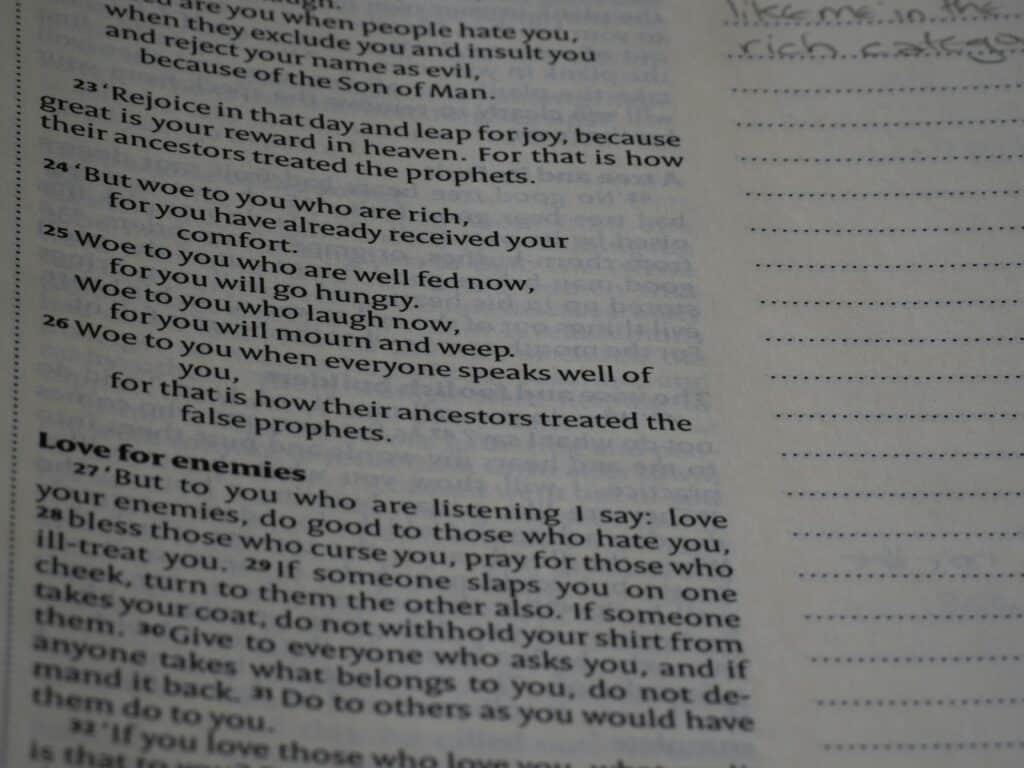
Matthew 5:44:
But I say to you, Love your enemies and pray for those who persecute you, …
Luke 6:27:
But I say to you who hear, Love your enemies, do good to those who hate you, …
It was then that I saw something I had never noticed before. The word “Love” is capitalized in both verses. But why? I decided to dive a little deeper, to find out what kind of “Love” the authors of these gospels, Matthew and Luke, were referencing.
These verses refer to Agape love, defined as the divine, unconditional, and sacrificial love of God…the love described is not a mere emotion, but a willful, profound act of benevolence. Love [in these verses] is both a noun and a verb – a choice and an action, not just a feeling. It implies a “God-level” of love that people are called to show towards others, even enemies….it differentiates between the “real thing” (divine, eternal Love) and the lesser, often fickle, forms of affection found in the world.
I turned my attention back to the Holy Spirit.
‘Ok, so you call me to pray for them – I can do that. But to love them, too?’
Prayer, in my opinion, was the easy ask. I immediately began to pray for their hearts – that truth would prevail over rumors and false characterizations.
I prayed that they would be blinded by the light of God that radiates from my friend, and that they would find compassion and understanding in their hearts, even to the extent of seeking forgiveness.
I prayed that even though I don’t know them personally, I’m thankful God does – their circumstances, their motivations, intentions, character and whether they are members of His Kingdom.
Now for the difficult part. “God, show me how to love them,” I prayed.
Praying for those who have hurt us or those close to us is one way to actively love them. If you find yourself burdened by those who have hurt you or someone you love, I encourage you to ask God to reveal how and what you can pray for them.
Oh yeah, and one more word of wisdom – keep thy mouth shut! That’s right – rather than speaking ill of those who have spoken ill of you or those you cherish, choose to keep quiet – shut that gossip down! Be mindful of the list of thoughts found in Philippians 4, where we are commanded to put our focus on things that are true, honorable, just, pure, lovely, commendable, excellent, and worthy of praise. Ask God to help you to look for and dwell on those things in everyone, especially those who persecute you.
A favorite quote of someone I met years ago is this: “Love them until they ask why.” Whenever you give someone something they don’t deserve – love over vengeance, kindness over malice, forgiveness over revenge – be prepared if they ask you why. If you are loving them not out of obligation, but out of obedience to the love that God offers them, a good answer may be, “I asked God to love you through me.”
God gave me a perfect testimony of Love in action. Although there are many in Scripture, this one I experienced firsthand through my persecuted friend. She never spoke malice, hatred, or vitriol towards those who wronged her. She even thwarted my efforts to do so!
This woman has chosen time and again to reply with a soft answer, one that would turn away wrath, rather than a harsh word which provokes anger (Prov. 15:1). She can do these things because she knows that her source of strength is not vengeance. Her strength comes from Christ and Christ alone. She chooses to fight the good fight in a humble manner, one worthy of praise, so that others won’t have to walk a similar road. When someone sins against her, she chooses to respond in a manner worthy of the Gospel.
What will your response be when someone speaks to you with animosity? What will you say or do when you find yourself in the crosshairs of rumors and accusations? And how will you stand when someone you love is misaligned and mistreated for things they never did? If you belong to Christ, my friend, you can respond as He instructs us. You can pray for your enemies. You can think about and speak about what is true, pure, and holy. And like my courageous and godly friend, you can choose Love.